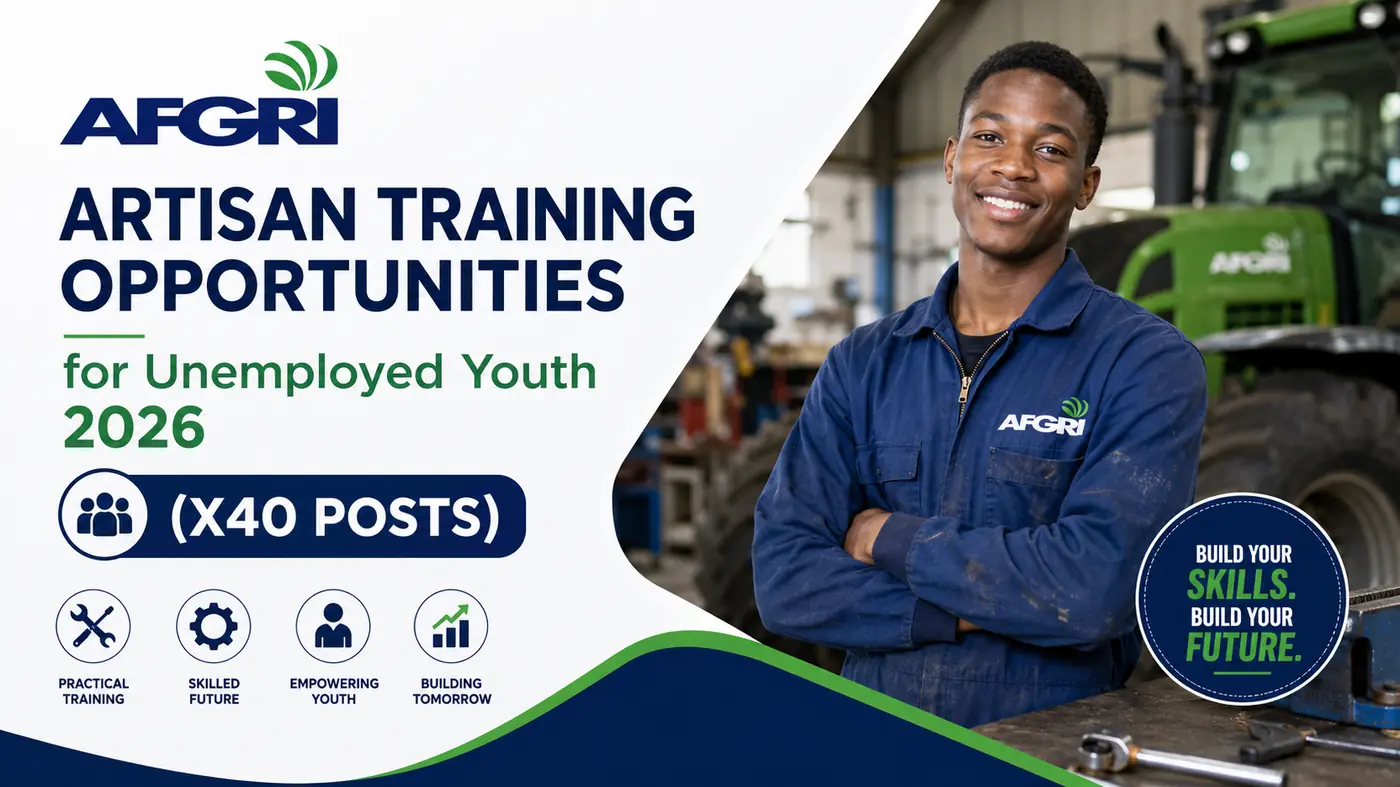
South Africa’s agricultural machinery and heavy equipment industries continue to face a growing demand for skilled artisans. For young people interested in technical careers, the AFGRI Equipment Artisan Training Opportunities 2026 offers a structured pathway into the tractor mechanic and earthmoving mechanic trades.
This artisan development programme combines workplace experience, technical learning, supplier-supported product training, and SETA-regulated qualification pathways over a three-year training period.
For matriculants with Mathematics or Technical Mathematics who want an alternative to university study, this programme may provide a strong long-term career opportunity within the mechanical and equipment maintenance sector.
Programme Information
- Reference Number: AO-2345
- Number of Positions: 40
- Closing Date: 30 September 2026
- Training Duration: 3 years
- Maximum Contract Period: 4 years
- Probation Period: First 6 months
- Minimum Qualification: Grade 12 with Mathematics or Technical Mathematics
Understanding the AFGRI Artisan Training Structure
The programme combines formal technical learning with practical workshop exposure over a structured training period.
Participants receive training through:
- workplace practical experience
- equipment servicing
- fault diagnostics
- preventative maintenance
- workshop operations
- technical learning phases
- supplier-led training
- distance learning modules
- structured assessments
- specialist mentorship
Some training phases may also include Saturday classes depending on programme requirements.
The Purpose of the 6-Month Probation Period
The first six months of the programme function as a probation and evaluation phase for both AFGRI and the learner.
During this stage, AFGRI evaluates:
- technical aptitude
- discipline
- teamwork
- workplace behaviour
- learning ability
At the same time, learners assess:
- whether the trade suits them
- the workshop environment
- long-term career interest
- training expectations
Either party may withdraw during the probation phase without penalties.
SETA Support and Qualification Recognition
The apprenticeship is supported by:
- AgriSETA
- MerSETA
These SETAs regulate artisan development and help ensure:
- national qualification recognition
- quality training standards
- workplace alignment with industry needs
- recognised trade certification pathways
This improves employability within technical and industrial sectors after qualification.
Skills Apprentices May Learn
Throughout the programme, apprentices may receive exposure to several important technical and workplace areas.
Mechanical Diagnostics
Learners may develop the ability to:
- identify machine faults
- diagnose mechanical problems
- recommend repair solutions
Equipment Servicing and Maintenance
Training may include:
- preventative maintenance
- servicing heavy machinery
- equipment inspections
- mechanical repairs
Workshop Operations
Apprentices may learn:
- tool handling
- workshop safety procedures
- workflow coordination
- maintenance processes
Parts and Inventory Management
Exposure may include:
- spare parts handling
- stock control
- inventory systems
- workshop material management
Customer and Operator Support
Learners may also assist with:
- communicating equipment issues
- customer support
- service documentation
- maintenance reporting
Duties of Apprentices
During the apprenticeship, participants may:
- train toward a recognised artisan qualification
- support workshop activities
- assist with machine servicing
- participate in equipment repairs
- maintain workshop systems
- assist with stock control
- complete technical learning requirements
- provide support during maintenance operations
Minimum Requirements
Applicants must meet the following requirements before applying.
Applicants must have:
- Grade 12 / Matric
- English
- Mathematics or Technical Mathematics
- valid South African driver’s licence
- computer literacy
- basic administrative ability
- communication skills
Applicants should note that Mathematical Literacy is not accepted.
Subjects That May Improve Selection Chances
Although not compulsory, the following subjects may strengthen applications:
- Engineering Science
- Physical Science
- Engineering Graphics and Design
- Diesel Trade Theory
- Motor Trade Theory
Personal Qualities AFGRI May Look For
Artisan programmes require discipline and commitment over several years.
Successful applicants are often:
- motivated
- reliable
- goal-driven
- detail-oriented
- willing to learn
- able to work under pressure
- team-oriented
Important Training Cost Conditions
The programme covers training costs provided learners successfully complete their modules.
However:
- failed subjects may need to be repeated at the learner’s own expense
- failed modules can delay qualification completion
- work-back obligations apply after training
Applicants who leave the programme early may be required to repay training costs.
Understanding the Work-Back Obligation
The work-back period is equal to the duration of the apprenticeship.
Example:
- 3 years of training = 3 years work-back commitment
This allows AFGRI to recover investment made in training and development.
Possible Placement Locations
Apprentices may be placed at various AFGRI branches across South Africa depending on operational requirements.
Possible locations include:
- Polokwane
- Bethlehem
- Brits
- Middelburg
- George
- Bellville
- Pietermaritzburg
- Empangeni
- Kempton Park
- Nelspruit
- Tzaneen
- Kokstad
Applicants should be prepared to relocate if required.
How to Apply
APPLY FOR THE ARTISAN TRAINING OPPORTUNITIES 2026 HERE
Helpful Job Application Guides