How to Calculate ATS Scoring When Applying for a Bursary
Quick Answer
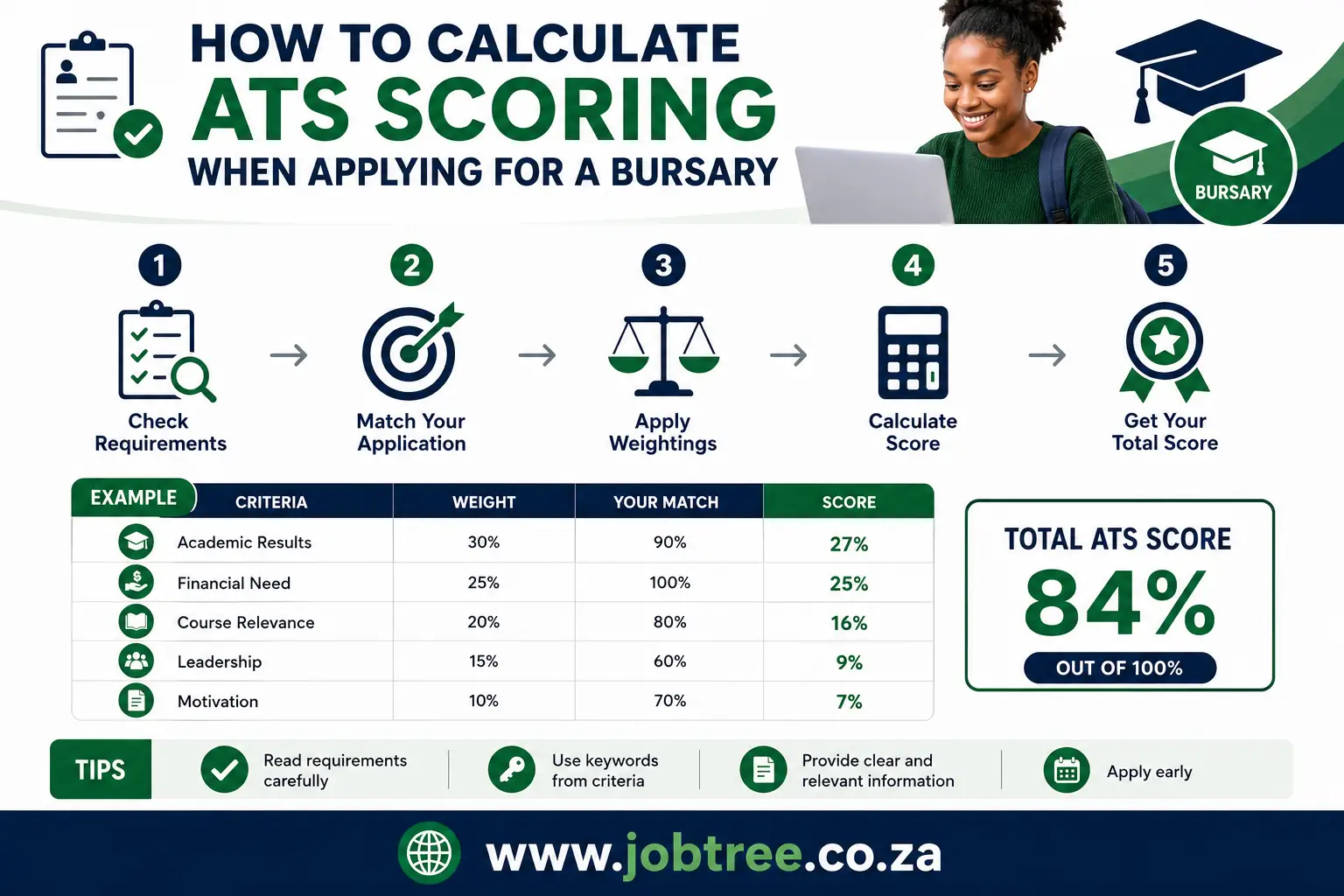
ATS scoring for bursary applications usually works by comparing your application against specific requirements such as academic results, keywords, study field, supporting documents, leadership activities, and financial criteria. The closer your application matches the bursary requirements, the higher your score is likely to be. Students can improve ATS scoring by using relevant keywords, submitting complete documents, and matching the bursary criteria carefully.
Table of Contents
- What Is ATS Scoring?
- How ATS Scoring Works for Bursaries
- Main Factors That Affect ATS Scores
- How to Calculate ATS Scoring Step by Step
- Example of a Strong ATS Bursary Score
- Example of a Weak ATS Bursary Score
- How to Improve Your ATS Score
- Common ATS Mistakes Students Make
- Frequently Asked Questions
What Is ATS Scoring?
ATS stands for Applicant Tracking System, which is software used by companies, universities, and organisations to organise and review applications automatically. While ATS systems are commonly used for jobs, some bursary programmes also use automated screening systems to filter large numbers of applications. These systems help organisations save time when thousands of students apply.
ATS scoring works by checking whether your application matches the bursary requirements listed in the advertisement or application form. The system may look for keywords, academic results, study fields, supporting documents, and other important information. Applications that match the criteria more closely often receive higher scores.
Students who understand ATS scoring can improve their applications by using the correct information, matching keywords carefully, and submitting complete documents. Even strong students can sometimes receive lower scores if important details are missing. Understanding how ATS systems work can improve bursary application success significantly.
How ATS Scoring Works for Bursaries
Most ATS systems work by assigning points to different parts of the application based on the bursary requirements. Academic marks, study field, leadership activities, financial need, and supporting documents may all contribute to the final score. Different bursaries use different scoring methods depending on what the organisation values most.
For example, an engineering bursary may place heavy importance on mathematics and science marks, while a leadership bursary may focus more on extracurricular activities and community involvement. Some bursaries also prioritise financial need or students from specific provinces or schools. Each requirement can contribute differently to the overall score.
The system usually compares the information in your application against keywords and requirements listed by the bursary provider. Students who include accurate information and relevant keywords often perform better during automated screening. This is why reading the bursary advertisement carefully is extremely important.
Main Factors That Affect ATS Scores
Academic results are usually one of the biggest factors affecting bursary ATS scoring because many organisations want students with strong educational performance. Mathematics, science, accounting, and English marks may carry extra importance depending on the field of study. Higher marks often improve scoring significantly.
Keywords inside your motivational letter, CV, and application can also affect ATS scoring. If a bursary focuses on engineering, technology, healthcare, or finance, students should naturally include those study-related terms where relevant. ATS systems often scan applications for important phrases linked to the bursary requirements.
Supporting documents also affect scoring because incomplete applications may lose points or become automatically rejected. Missing certified documents, proof of income, or academic records can reduce the quality of an application. Organisation and attention to detail are extremely important.
Leadership activities, volunteering, sports, and community involvement may also improve ATS scores because some bursaries look for well-rounded students with leadership potential. Students who participate in school or community activities often strengthen their applications. Extracurricular activities can help applications stand out.
Financial need can also play a major role because many bursaries are designed to support students from lower-income households. Proof of income and financial documentation may therefore influence selection decisions heavily. Some bursaries focus more on financial need than academic performance.
How to Calculate ATS Scoring Step by Step
The first step is identifying the bursary requirements listed in the advertisement or application form. Students should highlight important requirements such as minimum marks, study fields, required documents, leadership activities, and financial criteria. Understanding the criteria helps estimate how scoring may work.
The second step is assigning possible percentages or points to each category based on importance. For example, academic results may count for 40%, financial need 20%, leadership 15%, supporting documents 15%, and motivational letter quality 10%. Different bursaries may use different scoring structures.
The third step is comparing your own qualifications and documents against these categories. Students can estimate their strengths and weaknesses based on how closely they match the bursary requirements. Honest self-evaluation helps identify areas needing improvement.
The fourth step is adding estimated scores together to create an approximate ATS score. This is not an official bursary score, but it helps students understand how competitive their applications may be. Higher scores usually mean stronger alignment with the bursary criteria.
The final step is improving weak areas before submitting the application. Students may improve ATS scoring by strengthening motivational letters, updating documents, using better keywords, or improving academic performance over time. Preparation and attention to detail can increase competitiveness significantly.
Example of a Strong ATS Bursary Score
Imagine a bursary with the following scoring system:
- Academic Results – 40%
- Financial Need – 20%
- Leadership Activities – 15%
- Motivational Letter – 15%
- Supporting Documents – 10%
A student applying for an engineering bursary receives the following estimated scores:
- Academic Results: 35/40
- Financial Need: 18/20
- Leadership Activities: 12/15
- Motivational Letter: 13/15
- Supporting Documents: 10/10
Total Estimated ATS Score:
35 + 18 + 12 + 13 + 10 = 88/100
This would likely be considered a strong bursary application because the student meets most of the bursary requirements closely. Strong academic results, complete documents, and a good motivational letter helped improve the final score.
Example of a Weak ATS Bursary Score
Another student applies for the same bursary but submits incomplete documents and weaker academic results.
- Academic Results: 20/40
- Financial Need: 15/20
- Leadership Activities: 5/15
- Motivational Letter: 6/15
- Supporting Documents: 4/10
Total Estimated ATS Score:
20 + 15 + 5 + 6 + 4 = 50/100
This application may struggle during the bursary selection process because several important areas were weak. Missing documents and low academic performance reduced the overall score significantly. Poor preparation can lower ATS scoring even when a student qualifies.
How to Improve Your ATS Score
Students can improve ATS scoring by reading bursary requirements carefully and matching the application closely to the criteria. Keywords linked to the study field, leadership, career goals, and academic strengths should appear naturally inside the application and motivational letter. Relevance is extremely important during automated screening.
Keeping documents organised and complete is also very important because incomplete applications may lose points automatically. Certified copies, proof of income, academic records, and supporting letters should all be submitted correctly. Good preparation creates stronger applications.
Strong motivational letters can also improve ATS scoring because they help explain goals, financial need, leadership ability, and future career plans. Personalised and professional writing usually performs better than generic responses. Clear communication creates stronger impressions.
Academic improvement remains one of the best long-term strategies because many bursaries place heavy importance on marks and subject performance. Students should focus on maintaining strong averages and improving important subjects linked to their chosen careers. Academic consistency increases competitiveness.
Applying for bursaries that closely match your study field and qualifications also improves scoring potential. Students should focus on opportunities where they meet most or all requirements properly. Matching the bursary criteria carefully usually improves overall success rates.
Common ATS Mistakes Students Make
One common mistake is ignoring keywords listed inside the bursary advertisement. Students sometimes submit generic applications without matching the requirements properly. ATS systems may rank these applications lower because they appear less relevant.
Another common mistake is submitting incomplete applications with missing documents or incorrect information. Many systems automatically reject incomplete submissions before human review even begins. Attention to detail is extremely important during applications.
Poor motivational letters can also reduce ATS scores because they may not explain goals, leadership, financial need, or career interests clearly. Generic copied responses often weaken applications significantly. Personalised writing usually performs better.
Some students also apply for bursaries that do not match their study field or academic qualifications. This often leads to low scoring because the application does not align closely with the bursary requirements. Understanding eligibility criteria helps avoid wasted applications.
Late applications are another major problem because many bursary systems stop accepting applications immediately after the deadline. Planning ahead and submitting early can reduce unnecessary stress and technical issues. Good preparation improves application quality.
Frequently Asked Questions
What is ATS scoring for bursaries?
ATS scoring for bursaries is a method used to evaluate applications automatically based on requirements such as academic results, keywords, study field, leadership activities, financial need, and supporting documents.
Do bursary applications use ATS systems?
Some bursary programmes use automated systems to organise and filter large numbers of applications before human review begins. Larger organisations and companies are more likely to use these systems.
How can I improve my bursary ATS score?
You can improve your ATS score by matching the bursary requirements carefully, using relevant keywords, submitting complete documents, writing strong motivational letters, and maintaining good academic performance.
Can missing documents reduce ATS scores?
Yes, missing documents can reduce ATS scores significantly or even cause automatic rejection because many systems require complete applications before processing.
Browse more education and career advice on JobTree.
Read this related guide: How to Check if You Qualify for a Bursary.