The Different Types of Learnerships Offered in South Africa
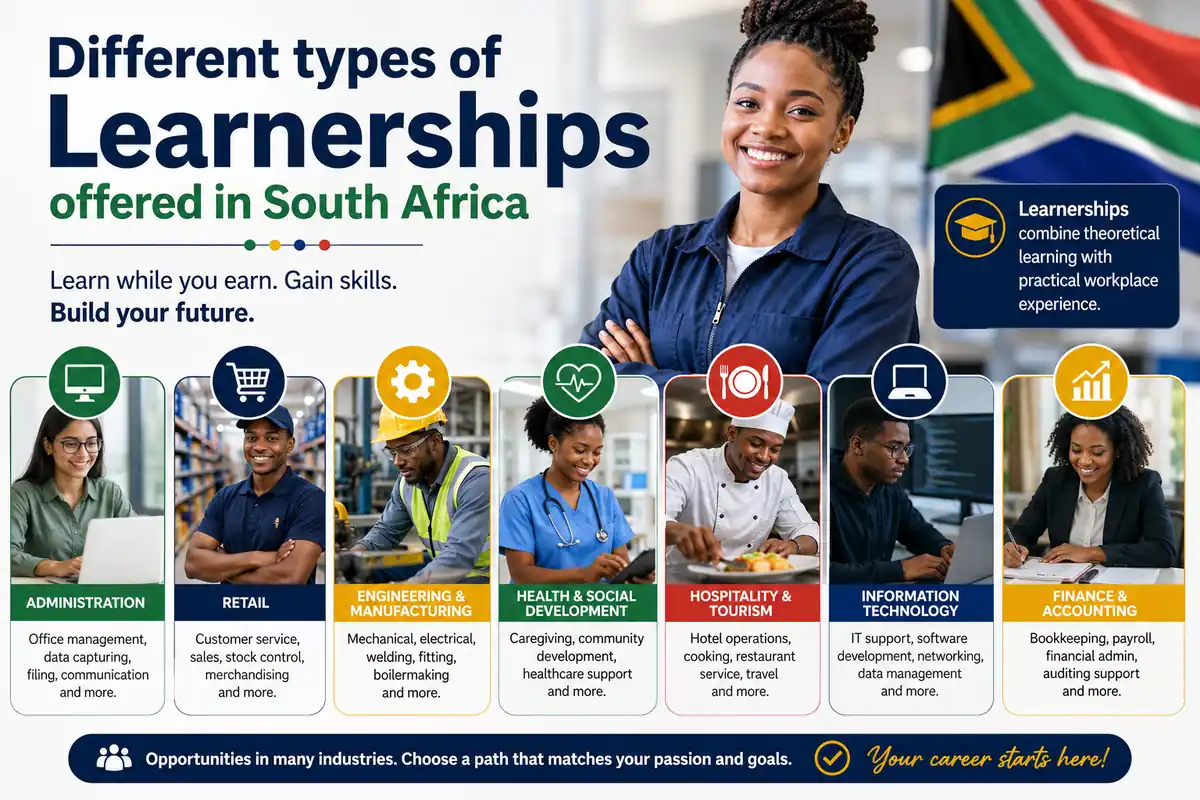
Quick Answer
South Africa offers many different types of learnerships across industries such as business administration, retail, information technology, engineering, healthcare, logistics, hospitality, finance, and customer service. Learnerships combine practical workplace experience with structured training to help participants gain skills and recognised qualifications. Different learnerships have different qualification requirements depending on the industry and career path.
Table of Contents
- What Is a Learnership?
- Business Administration Learnerships
- Information Technology Learnerships
- Retail and Wholesale Learnerships
- Finance and Banking Learnerships
- Engineering and Technical Learnerships
- Logistics and Freight Learnerships
- Healthcare Learnerships
- Hospitality and Tourism Learnerships
- Customer Service and Contact Centre Learnerships
- Management Learnerships
- SETA Learnerships
- Where to Find Learnership Opportunities
- Frequently Asked Questions
What Is a Learnership?
A learnership is a structured training programme that combines workplace experience with classroom-based learning to help participants gain practical skills and recognised qualifications. Learnerships are widely used in South Africa to help unemployed youth and entry-level workers gain work experience while learning industry-specific skills. Many programmes also provide monthly stipends during training. :contentReference[oaicite:0]{index=0}
Learnerships are usually managed through SETAs, also known as Sector Education and Training Authorities, which focus on skills development in different industries. Every SETA supports learnerships linked to specific career sectors such as finance, engineering, retail, information technology, hospitality, and healthcare. South Africa currently has multiple SETAs covering different industries and occupations. :contentReference[oaicite:1]{index=1}
Most learnerships lead to nationally recognised qualifications registered on the National Qualifications Framework (NQF). These programmes are designed to improve employability while helping businesses develop skilled workers. Learnerships remain one of the most popular entry routes into the South African workforce. :contentReference[oaicite:2]{index=2}
Business Administration Learnerships
Business administration learnerships are among the most common learnerships offered in South Africa because many companies require office administration and support staff. These programmes usually focus on communication, office management, document control, scheduling, customer service, and workplace professionalism. They are popular across both private and public sectors. :contentReference[oaicite:3]{index=3}
Business administration learnerships are often offered through the Services SETA and may require applicants to have Grade 12 with basic English and communication skills. Participants usually gain practical office experience while completing theoretical training modules. These programmes can improve opportunities for administration and office careers. :contentReference[oaicite:4]{index=4}
Many applicants choose business administration learnerships because they provide transferable workplace skills that can be used across multiple industries. Communication, organisation, teamwork, and computer literacy remain valuable in almost every workplace environment.
Information Technology Learnerships
Information technology learnerships focus on digital skills such as IT support, systems support, software development, technical support, networking, and end-user computing. These programmes have become increasingly popular because businesses continue investing heavily in technology and digital systems. IT skills remain highly valuable in the modern economy. :contentReference[oaicite:5]{index=5}
Many IT learnerships are supported through MICTSETA and may include training in programming, cybersecurity, troubleshooting, databases, or computer systems support. Participants usually gain both classroom training and practical workplace exposure during the programme. Some programmes also include industry certifications. :contentReference[oaicite:6]{index=6}
Technology learnerships can provide strong long-term career opportunities because digital skills continue showing strong demand in South Africa and internationally. Applicants with strong problem-solving abilities and computer interest often perform well in these programmes.
Retail and Wholesale Learnerships
Retail and wholesale learnerships are commonly offered because the retail sector employs large numbers of workers across South Africa. These programmes usually focus on customer service, merchandising, stock control, sales, cashier operations, and retail management. Retail learnerships are often suitable for entry-level job seekers. :contentReference[oaicite:7]{index=7}
Wholesale and retail learnerships are commonly linked to W&RSETA and may be offered by supermarkets, clothing retailers, wholesalers, and shopping chains. Participants gain practical experience while learning how retail operations function in real workplace environments. Customer interaction skills are usually important in these programmes. :contentReference[oaicite:8]{index=8}
Retail learnerships remain popular because they often provide accessible entry opportunities for young South Africans with limited work experience. Many retail companies also offer future employment opportunities after successful completion of the programme.
Finance and Banking Learnerships
Finance and banking learnerships focus on accounting, bookkeeping, financial administration, banking operations, customer service, and financial systems. These programmes are often offered through banks, accounting firms, insurance companies, and financial organisations. Finance learnerships can help participants build valuable office and analytical skills. :contentReference[oaicite:9]{index=9}
Some programmes include accounting technician training, bookkeeping qualifications, or financial administration skills linked to FASSET. Participants may work in offices while learning about financial records, reporting, customer accounts, and administrative processes. Attention to detail is extremely important in finance-related careers. :contentReference[oaicite:10]{index=10}
Banking and finance learnerships can create pathways into long-term careers because the financial sector continues requiring skilled administrative and customer service professionals. Communication and professionalism are highly valued in these industries.
Engineering and Technical Learnerships
Engineering and technical learnerships focus on practical and technical skills linked to industries such as manufacturing, construction, electrical work, mechanics, and industrial operations. These programmes are often offered through MERSETA and CETA depending on the industry. Technical learnerships usually combine practical workplace training with technical education. :contentReference[oaicite:11]{index=11}
Engineering learnerships may include fields such as mechanical engineering, construction roadworks, welding, electrical maintenance, technical support, or artisan development. Some programmes can continue across several NQF levels before participants qualify fully in technical trades. Practical skills are extremely important in these careers. :contentReference[oaicite:12]{index=12}
Technical learnerships remain valuable because South Africa continues experiencing demand for skilled technical workers in infrastructure, manufacturing, and engineering sectors. These careers can also provide strong long-term earning potential.
Logistics and Freight Learnerships
Logistics and freight learnerships focus on supply chain operations, warehousing, transport coordination, freight handling, and distribution systems. These programmes are becoming increasingly important because businesses rely heavily on transport and supply chain management. Logistics careers continue growing across South Africa. :contentReference[oaicite:13]{index=13}
Participants may learn about stock management, warehouse operations, freight handling, driving operations, or distribution planning during these programmes. Some learnerships are linked to TETA and freight management qualifications. Organisation and planning skills are important in logistics careers. :contentReference[oaicite:14]{index=14}
The growth of online shopping and large distribution networks has increased the importance of logistics and freight skills across many industries. These programmes can therefore create valuable long-term career opportunities.
Healthcare Learnerships
Healthcare learnerships focus on medical support services, healthcare assistance, administration, and community health training. These programmes may be offered through healthcare organisations, hospitals, clinics, or health-related SETAs. Healthcare remains one of the most important industries in South Africa. :contentReference[oaicite:15]{index=15}
Some healthcare learnerships focus on community health work, healthcare administration, patient support, or caregiving skills depending on the programme. Participants usually learn both practical healthcare skills and workplace professionalism. Compassion and communication skills are often important in these careers.
Healthcare learnerships can provide pathways into long-term healthcare careers because medical services remain essential regardless of economic conditions. Demand for healthcare support workers continues across many communities.
Hospitality and Tourism Learnerships
Hospitality and tourism learnerships focus on customer service, hotel operations, catering, food preparation, tourism services, and hospitality management. South Africa’s tourism and hospitality sectors continue providing opportunities for entry-level job seekers and service professionals. :contentReference[oaicite:16]{index=16}
Participants may gain experience in hotels, restaurants, tourism businesses, events, or customer-facing hospitality environments while completing practical and classroom training. Communication and customer service skills are especially important in hospitality industries.
Hospitality learnerships can help participants build confidence, professionalism, and service skills that remain useful across many industries. Customer interaction experience often improves future employability significantly.
Customer Service and Contact Centre Learnerships
Customer service and contact centre learnerships focus on communication, problem-solving, customer support, and call centre operations. These programmes are commonly offered through customer service providers, telecommunications companies, retailers, and outsourcing businesses. Communication skills are extremely important in these careers. :contentReference[oaicite:17]{index=17}
Participants usually learn how to handle customer queries, complaints, service requests, and communication systems while gaining workplace experience. Many programmes also focus on professionalism, teamwork, and workplace etiquette. Customer service remains one of the largest employment sectors in South Africa.
These learnerships are often popular among young job seekers because they provide accessible entry-level opportunities and practical workplace experience. Strong communication and people skills can improve long-term career growth in customer-facing industries.
Management Learnerships
Management learnerships focus on leadership, supervision, workplace coordination, and business management skills. These programmes may be suitable for individuals who want to develop management knowledge and improve their career growth opportunities. :contentReference[oaicite:18]{index=18}
Participants may learn about team management, workplace planning, communication, leadership, and operational management depending on the programme. Some management learnerships are designed for entry-level workers while others target employed staff looking to develop leadership skills.
Management skills remain valuable across almost every industry because businesses require supervisors, coordinators, and team leaders to manage operations effectively. Leadership development can improve long-term career progression significantly.
SETA Learnerships
Most learnerships in South Africa are linked to SETAs, which manage skills development and industry training programmes. Different SETAs focus on different industries such as finance, retail, engineering, agriculture, hospitality, transport, and information technology. SETAs help coordinate qualifications and workplace training. :contentReference[oaicite:19]{index=19}
Examples include MICTSETA for information technology, MERSETA for engineering and manufacturing, W&RSETA for retail, TETA for transport and logistics, and SERVICES SETA for administration and customer service industries. Each SETA supports learnerships linked to its sector. :contentReference[oaicite:20]{index=20}
Understanding which SETA supports your chosen industry can help applicants find more targeted learnership opportunities. Many learnership advertisements also mention the SETA linked to the programme.
Where to Find Learnership Opportunities
Learnership opportunities are commonly advertised on company websites, SETA portals, government websites, recruitment platforms, and career websites across South Africa. Different industries publish opportunities throughout the year depending on training and recruitment needs.
JobTree regularly posts learnership opportunities in South Africa, including programmes from banks, retailers, telecommunications companies, government departments, and training providers. Job seekers can browse available learnerships, internships, bursaries, and graduate opportunities on JobTree.
Checking platforms regularly can improve your chances because many learnership opportunities receive large numbers of applications shortly after opening. Early preparation and organised documents can improve application quality significantly.
Frequently Asked Questions
What are the most common learnerships in South Africa?
Some of the most common learnerships include business administration, retail, customer service, information technology, logistics, finance, and engineering programmes. :contentReference[oaicite:21]{index=21}
Do learnerships provide qualifications?
Yes, most learnerships lead to nationally recognised qualifications registered on the National Qualifications Framework (NQF). :contentReference[oaicite:22]{index=22}
Are learnerships paid?
Many learnerships provide monthly stipends to help participants cover transport and basic living expenses during training. :contentReference[oaicite:23]{index=23}
Where can I apply for learnerships?
Learnerships are commonly advertised on company websites, SETA portals, government websites, recruitment platforms, and career websites such as JobTree.
Browse more career opportunities and learnerships on JobTree.
Read this related guide: How to Choose the Right Learnership for You.